
The beginning of another school year is a time of transition for families. Busy schedules, classroom struggles, the everyday highs and lows of both growing up and parenting–it can be a lot for any family to navigate. But for families separated by prison walls, every challenge is compounded, and both the children and the adults involved pay the price. This Weekly Perspective explores the impact of parental incarceration and discusses pro-family policy reforms.
The Cost of Parental Incarceration on Children
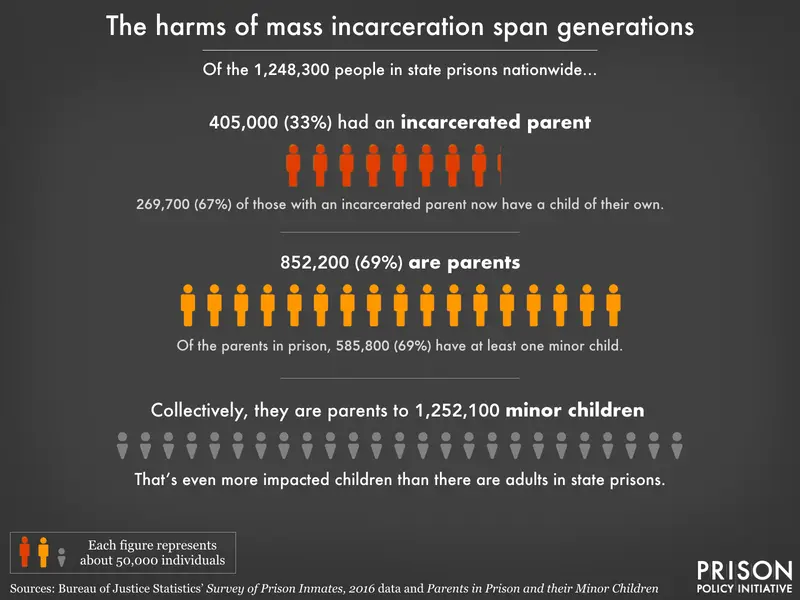
2023 data from Kids Count found that in 2023, at least 8% of Missouri kids had a parent who was incarcerated during their childhood. Parental incarceration is a generational trauma: research published by Prison Policy Initiative in 2022 (using data from a 2016 BJS survey) found that of the over one million people incarcerated in state prisons, 69% are parents, and 33% had themselves been the child of an incarcerated parent. Children whose parents are incarcerated face a higher risk of mental health challenges, including post-traumatic stress disorder, anxiety, and clinical depression, as well as behavioral difficulties, substance abuse, and involvement with the criminal legal system. People who experienced parental incarceration are, on average, 2.5 times more likely to attempt suicide than those whose parents were never incarcerated. They are also more likely to repeat a grade, less likely to complete high school, and more likely to face challenges developing the social and attentional skills needed for academic success. In addition, parental incarceration is associated with asthma, migraines, high cholesterol, and a greater risk of developing cancer or experiencing a heart attack later in life. Despite all of this, children dealing with parental incarceration can also be incredibly resilient. Policy reforms that support children and their families can build upon this resiliency.
Pro-Family Policy Solutions
Missouri has had two policy wins in recent years that support families impacted by the criminal legal system. Our friends at Missouri Appleseed were instrumental in advocating for both. The first came in 2021 with the passage of SB 53, a sweeping omnibus bill that included a small but significant change for defendants who are primary caregivers of minor children. Courts must now consider ordering participation in community-based treatment programs as a sentencing alternative if the defendant is the primary caregiver of one or more dependent children and meets certain other specified requirements (RSMO 559.120). The bill also requires that the Missouri Department of Corrections have a community correction program that will “promote opportunities for nonviolent primary caregivers to care for their dependent children” (RSMO 217.777). This legislation was an important step in expanding diversion options for parents and caregivers.
In 2022, Missouri lawmakers passed SB 683. This bill made multiple changes to childcare laws and included language to establish a prison nursery in Missouri for women with 18 months or less left on their sentences, allowing mothers and infants to bond and to leave prison together. The nursery was opened in January 2025 at WERDCC (Women’s Eastern Reception and Diagnostic Correctional Center in Vandalia), and by the end of the program’s first year, it was home to 15 mothers and 16 babies (including one set of twins). Prison nurseries exist in eight other states, with Missouri being the most recent state to create one. Research shows that children who lived in prison nurseries between the ages of 0 and 18 months are less likely to experience anxiety and depression than preschool-age children who experienced parental separation from incarcerated mothers. While the creation of this nursery is a huge win for our state, further reforms should consider alternatives to incarceration for pregnant women and programs to support the attachment bond between young children and fathers.
Missouri can support families impacted by the criminal legal system in many ways, from expanding diversion opportunities and early release pathways for primary caregivers to improving currently available resources for incarcerated parents and their children. The ideas explored below may be more feasible for shorter-term advocacy than policies that would require significant changes to sentencing structure.
Child-Friendly Visiting
Face-to-face visits are incredibly important for maintaining and strengthening the relationship between an incarcerated parent and their child. However, a prison visit can be an uncomfortable, emotional, and even traumatizing experience for a child when visiting policies and procedures do not consider children. For some families, parents or caretakers may feel that the benefits of a visit are not worth the challenges their child faces during or after a visit. Recommendations from the 2025 report “Supporting Children with Incarcerated Parents: An Action Plan for Policymakers” highlight that the first step toward improvement is to review the current visiting process, with input from children and family members. Visiting spaces should be colorful and appealing to children, and include playgrounds or other outdoor areas. Correctional staff should receive child-specific trauma-informed training, and children should be helped to understand visiting procedures and what to expect ahead of time through a handbook, video, or website. Physical contact should be allowed, and when it is not, it should be clearly communicated to children, and not met with an outsized reaction from correctional staff if a child tries to hug or reach out to their parent. Many families live far from the prison their loved one is incarcerated in, making regular visits inaccessible. Programs that offer free or reduced-cost transportation for families should be created, and existing programs expanded and supported.
Communication Support for Families
Video visiting can be a valuable addition to in-person visits, but should never replace in-person visiting. Currently, video visits cost Missouri families $6.90 for a 30-minute call. This price makes regular video calls inaccessible for many families, and policymakers should consider free video calling for visits between incarcerated parents and their children. Additional changes to communication options for families should be made, such as the ability for incarcerated parents to teleconference for parent-teacher conferences and free phone calls for parents and children.
Parenting Curriculum
Parenting programs can be an effective intervention to support families. Classes inside prison are often led by outside community organizations or individual volunteers; however, some level of administrative investment is needed for a program to be routinely and adequately staffed (including correctional staff assigned to the area of the prison class) and available throughout the state. Programs should also have tailored content specific to incarcerated parents. Lastly, priority should be given to the creation of programs that involve both parents and their children through visits and classes in both prison and the community.
In addition to creating a more supportive environment for children, all of the policies and programs reviewed here have been shown to reduce recidivism when incarcerated parents return home. This benefit of improving public safety for all is coupled with the cost savings to the state in reduced likelihood of future incarceration, for both parents and their children. Many of the recommendations discussed here could be done without legislation, through administrative actions by DOC leaders. We are excited to work with partners, child advocacy organizations, the Department of Corrections, and policymakers to adopt pro-family reforms for all Missouri families.
 English
  Spanish