
Any Big Bang Theory fans out there? I recently started watching the series again and that led me down the fandom rabbit hole to Young Sheldon and then Georgie and Mandy’s First Marriage. You might be wondering what modern day television has to do with affordable housing and here’s our first insight: alternative housing options have been been in the media for quite some time with shows like Parenthood, This Old House and even AARP’s Future of Housing series featuring Alternative Dwelling Units (ADUs) and innovating strategies for creating more affordable housing for ourselves, our loved ones, our families, friends and neighbors.
Commonly called ADUs, Accessory Dwelling Units are also known as guest houses, casitas, backyard cottages, English basements, in-law suites, tiny homes, secondary apartments, and grandparent flats. ADUs also appear when people remodel an existing garage, basement or upgrade an area of their home into a living space for others. Remember Fonzie? He lived in the remodeled apartment above the Cunningham’s garage and that was in Milwaukee in the ’50s.
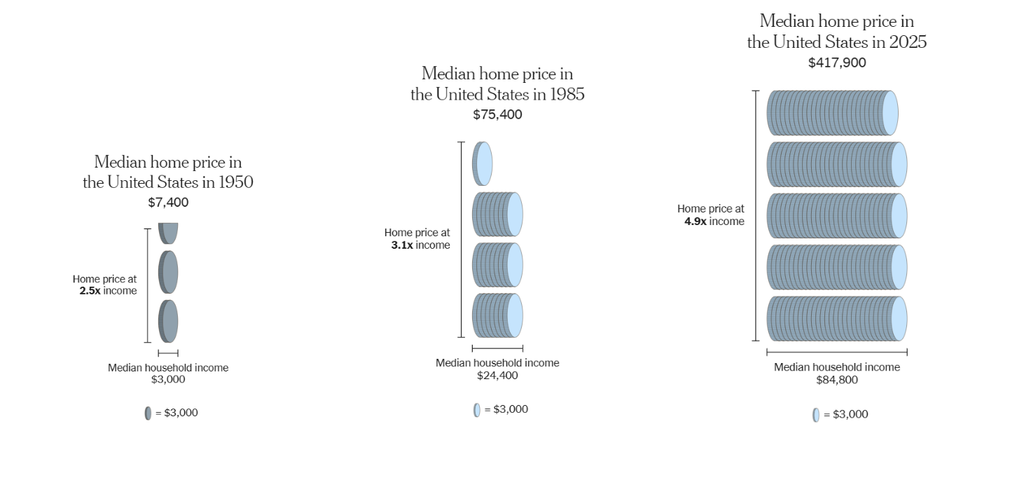
While times have changed drastically from the 1950s until now, one pillar of the American dream remains the same: homeownership. The New York Times shows that an average US home price in the 1950s was a mere $7,400, approximately 2.5 times the median annual household income at that time.
To reach that dream of American homeownership today, you might be surprised to learn that, according to the same New York Times study, the average US home price was found to be almost five times the median household income, at $417,900.
Enter Georgie and Mandy. 🙂 🏡 ❤️
Along with the famous Fonz, this happy couple found their first home right next door to Georgie’s parents, converting their garage into a fully-functional independent living space. While their first nest wouldn’t legally qualify as an ADU due to their bathroom setup, it did provide a space for the couple to grow their family, save for a place of their own, and receive intergenerational support from loved ones and friends.
Part 1 of our ADU Trilogy will educate us on what an ADU is and set the scene for why Accessory Dwelling Units are a simple solution for providing more affordable housing in Missouri.
Part 2 of our ADU Trilogy will dive deep into the benefits of Accessory Dwelling Units.
Part 3 will cover certain bumps in the road that can sometimes elongate the building and financing processes.
For now, let’s keep going full steam ahead here in Part 1 as we set up our ADU framework (pun definitely intended). 🙂
First, let’s cover a few basics.
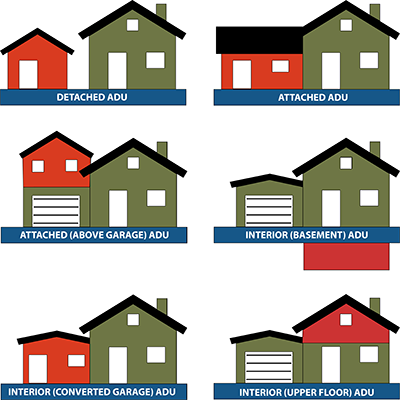
An Accessory Dwelling Unit can be:
- An internal converted portion of an existing home
- An attached addition to a new or existing home
- A detached stand-alone structure or converted portion of existing homes
To legally be classified as an Accessory Dwelling Unit, an ADU must be a self-contained space that offers both proximity and privacy, including:
- A separate entrance
- A bedroom or sleeping area
- A full bathroom
- A kitchenette or full kitchen
- Extra living space for work or leisure
Accessory Dwelling Units (ADUs) are smaller additional housing units that can be lived in by seniors, young adults, individuals with disabilities, their caregivers and / or family members with limited income.
Some pros of ADUs are that they:
- Have the potential to increase housing affordability (both for homeowners and tenants)
- Create a wider range of housing options within the community
- Enable our aging loved ones to stay near family
- Facilitate better use of existing housing landscapes in already established neighborhoods.
- Provide an alternative and sustainable option for expanding safe, accessible, affordable housing across our nation and especially in Missouri.
Simply stated, ADUs are smaller, independent, residential housing units located on the same lot as a stand-alone single family home. However, certain hurdles still exist in what seems like should be a simple process: allowing homeowners the freedom to use their properties in ways that best benefit their families.
Accessory Dwelling Units are quite nuanced, providing a multitude of options for a family’s unique needs. Several municipalities in Missouri have already passed local legislation allowing this possibility in new housing creation and states like Arkansas and Arizona have passed by-right laws allowing homeowners to build on their properties and truly encapsulate the freedom to choose what’s best for themselves, their families, and their futures.
Stay tuned for the next two parts in our ADU Trilogy and reach out to [email protected] to learn more about ADU Legislation in Missouri!
Part 2 Preview: Benefits of ADUs for you and your family
- Allow intergenerational households to remain together
- Provide aging loved ones the ability to age in place with dignity
- Offer financial freedom, flexibility in lifestyle, and economic vitality
- Add to a community’s impact in terms of growth and sustainability
 English
 Spanish