
This is part of an ongoing series looking at the impact of missed court appearances in Missouri. Check out part one in this series, Mass Incarceration in Your Backyard, for additional context about this issue.
Background
Empower Missouri is exploring the issue of automated court reminders in our state, a tool that reduces missed court appearances and, in turn, jail incarceration: research from Pew Charitable Trusts found that court reminders reduce nonappearance rates by up to 61%. In addition to worse outcomes for defendants, each missed court appearance costs states approximately $2,800 per case, according to research from ideas42. Missouri utilizes a free court reminder system called “Track This Case,” a program initially launched in 2016.
To learn more about how “Track This Case” is promoted and utilized, we sent out a questionnaire to circuit court clerks around the state. In most counties, the circuit court clerk is an elected position. In a few counties, circuit court clerks are appointed. These individuals are responsible for a wide range of administrative duties that keep the courts running, and for overseeing the teams of court clerks in each circuit. As such, this group is very familiar with the reality of missed court appearances and the resulting impacts on court functions. With the questionnaire, we hoped to glean insights into how these influential court administrators promote use of the automated court reminder system “Track This Case,” and to identify potential pain points and areas for improvement. After compiling a list of circuit court clerk emails, we contacted them via individual emails and followed up with a phone call about a week later. A final email appeal was sent out approximately one month after the initial email was sent.
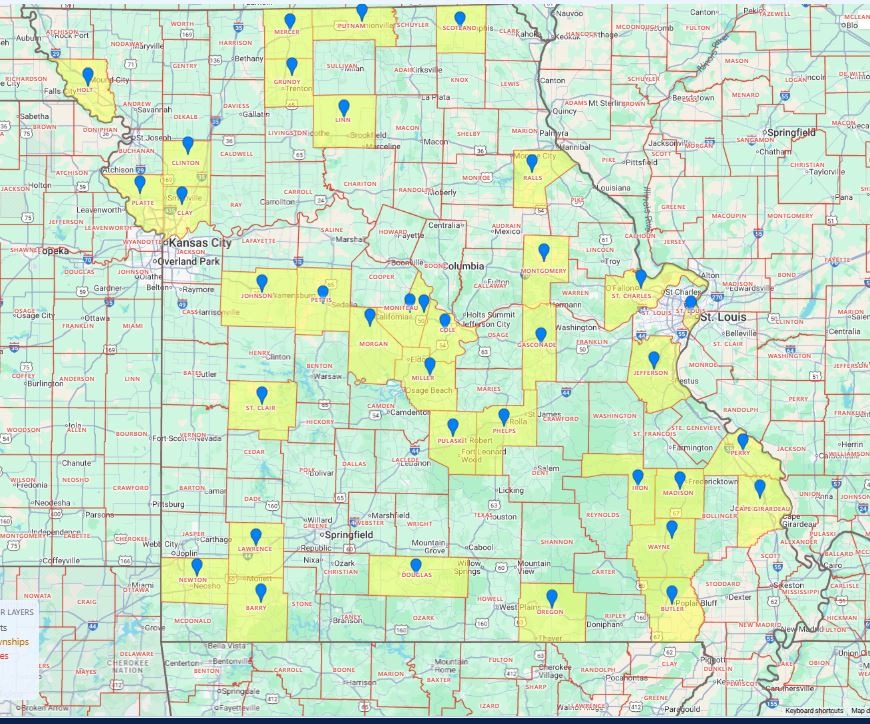
Missouri’s 115 counties are grouped into 46 circuit courts. The responses came from 27 out of Missouri’s 46 circuit courts (59% of circuit courts) and 34 out of 115 counties throughout the state (30% of counties). See the map below for a visual of what counties were represented in our pool of respondents. We received 36 responses to the questionnaire.
Results
The responses received provide a window into how court personnel view the current court reminder system. When asked about the system’s effectiveness, nearly half of respondents responded that they were “unsure.” The majority of respondents (56%) said that their court does not promote the court reminder text program to defendants. Most of those that did promote the program utilized cards or flyers, both posted in the courts and given directly to defendants.
When asked how the current system may be improved, there was a single most common response: 55% of respondents did not have any recommendations for improvement. The next most common category of response (11%) said the onus is on the court-goer to participate in the system. Nearly half of respondents (47%) indicated that their court has FTAs “often.” Two-thirds of respondents answered that their court does not maintain any data on missed court appearances, and 92% answered that their court does not maintain data on usage of the court text reminder program. A question about how courts are impacted by missed appearances yielded many similar responses citing strains on court personnel, over-loaded dockets, and financial losses.
When looking at the responses across all questions, one primary theme emerged. This framing of the issue of missed court appearances attributes the sole fault to defendants, rather than acknowledging a systemic problem. If these responses are indeed indicative of a broader feeling amongst court personnel, it is troubling. Such an attitude could be counterproductive to promoting the use of court reminders with defendants in a manner that is helpful, accessible, and judgment-free.
Another apparent theme from the respondents: technological barriers and potential technological solutions. Lack of access to the internet, particularly for rural defendants, as well as limited and unreliable cell phone access, make it difficult for some to utilize the court reminder service. One respondent said that since many people don’t check their email, a phone app would provide a better alternative. Other responses suggested changes that could be made to the website, from broken image links that need updating to increasing the text size for “Track This Case” to make it more visible.
Finally, a consistent theme that came up across multiple questions and responses included respondents simply not having any input on identifying issues or suggestions to offer. This sentiment could represent a larger feeling that these problems are out of the hands of individual court actors, or that there are no issues with the current system.
Next Steps
This questionnaire has been an illuminating first step in gaining a better understanding of the state of automated court reminders in Missouri. Now that we have insights from court clerks, we will turn to collecting input from court goers who have been impacted by missed court appearances. We have put out a call for individuals to share their stories and have already received nine responses through our Google form. We have also submitted a request for relevant data about Track This Case usage and appearance rates to OSCA. Finally, we have assembled a team of stakeholders from organizations serving court-involved clients to serve as a steering committee for the next phase of this project, and we will be sharing the results of this questionnaire at our next meeting for discussion.
Questionnaire responses were received from counties highlighted in yellow.
Further Reading
States Underuse Court Date Reminders | The Pew Charitable Trusts
Appearance Rate Technical Assistance Report | National Center for State Courts
Millions of People in the U.S. Miss Their Court Date, With Dire Consequences | Vera Institute
Improving Court Attendance: The Essential Guide to Court Reminder Programs | ideas42
 English
  Spanish